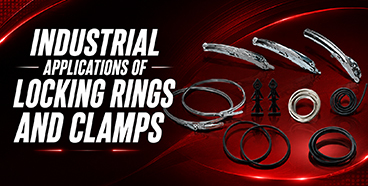
A locking ring is a simple component doing a demanding job. It holds a drum or pail lid against a gasket with enough uniform force to keep a seal through stacking, handling, thermal cycling and a long journey, and it has to release cleanly when someone needs the contents.
Most published material on this component describes the types. Less is written about how requirements actually change between sectors, which is where specification decisions get made. Below are the industrial applications of locking rings and clamps, and what each sector asks of them.
The most demanding application, and the one that drives most specification decisions. Chemical drums face aggressive contents, regulated transport, and consequences of failure that extend well past product loss.
Bolt-type rings are the usual choice because the closing force is measurable and repeatable through the bolt torque, rather than dependent on operator technique. Gasket compatibility becomes the critical variable. A ring that performs perfectly can still leak if the gasket compound is attacked by the contents, so the gasket is specified against the formulation and not the drum.
For regulated goods, the ring is part of the certified packaging assembly and cannot be substituted freely.
High throughput, long storage periods and outdoor yard conditions in this sector. Drums are frequently stacked and often sit for months before use.
The performance requirement is sustained sealing force through thermal cycling. In Gulf conditions the daily swing between yard temperature and night can be substantial, and a ring that relaxes across those cycles allows the gasket to lose compression. Ring material and gauge matter more than they appear to, and corrosion resistance on the ring itself affects whether it can be reused.
This sector also runs the largest reconditioned drum pools, so ring durability across multiple cycles carries direct cost impact.
Two competing requirements here. The contents include solvents that attack many gasket materials, and the container is opened repeatedly during use rather than emptied at once.
Lever lock rings are common because they allow quick opening and reclosing without tools. The trade-off is that closing force depends on the lever mechanism and operator handling rather than a measurable torque, so consistency varies more than with bolt rings. Where the coating is solvent-heavy and stored long, bolt rings are often specified despite the handling penalty.
Hygiene changes the specification. Ring and clamp surfaces must be cleanable, resistant to washdown chemistry, and free of crevices that harbour residue. Gaskets have to meet food-contact requirements, which restricts the compound options considerably.
Edible oil in particular combines long storage with oxidation sensitivity, so seal integrity affects product quality and not only containment. Stainless or appropriately coated hardware is common where washdown is frequent.
Lower volumes, higher value, tighter documentation. Requirements centre on contamination control and traceability rather than mechanical extremes.
Cleanability and particulate control drive material and finish choices. Component traceability matters because the packaging forms part of the documented supply chain, so batch records on rings and gaskets are frequently required alongside the drum itself.
A demanding combination: aggressive formulations, regulated transport classification, exposure to sun and heat in storage and field distribution, and end users who may not have handling equipment available.
Gasket compatibility against the specific formulation is again the deciding factor, since agrochemical carriers and surfactants vary widely between products with similar labels. Tamper evidence carries additional weight because counterfeit product is a persistent problem in this sector.
Site conditions rather than chemistry drive requirements here. Containers get moved roughly, opened partially, resealed with dust and cured residue on the sealing surface, and stored outdoors.
Practical resealability matters more than in almost any other sector. Lever rings suit the handling reality, and gasket durability against repeated compression cycles becomes the limiting factor on how many times a drum can be resealed reliably.
Drums used for waste collection and solvent recovery face mixed and sometimes unknown contents, repeated cleaning at temperature, and long service lives.
Ring durability and corrosion resistance take priority over unit cost, because the component is expected to survive many cycles. Inspection criteria matter here: knowing when a ring should be retired rather than reused is what prevents a failure in the field.
Across every sector, three practices separate reliable sealing from intermittent leakage.
Metro International L.L.C supplies locking rings, clamps, rubber gaskets and drum sealing accessories across chemical, lubricant, food and industrial applications, together with the tools required to apply them consistently.
1.What is the difference between a bolt ring and a lever lock ring?A bolt ring closes to a measurable torque and suits long storage and regulated goods. A lever lock ring opens and closes quickly without tools and suits containers accessed repeatedly during use.
2.Can locking rings be reused? Rings are commonly reused subject to inspection for deformation and corrosion. Gaskets are consumable and should be replaced at each reseal.
3.Why does a drum leak even when the ring is fully tightened?Usually because the gasket is incompatible with the contents, or because the lid curl or drum flange is deformed and the gasket cannot make continuous contact regardless of closing force.
4.What industries commonly use locking rings and clamps?Locking rings and clamps are commonly used in chemical, lubricant, paint, food, agricultural, and industrial manufacturing applications where secure closure of drums, pails, and other containers is required.
5.How do locking rings and clamps improve industrial container safety?They help keep container lids securely positioned and maintain closure integrity during handling, stacking, storage, and transportation, reducing the risk of accidental opening or product leakage.
6.How should the right locking ring or clamp be selected for an industrial container?Selection should consider the container size, lid design, material, closure type, product requirements, and expected handling or transportation conditions to ensure a secure and compatible fit.