Walk through any lubricant blending plant, chemical filling operation or paint manufacturer and the closures on the drums and pails will be metal. That has held steady while polymer technology has advanced considerably around it, which is worth examining rather than assuming.
Industrial packaging asks different questions of a closure than consumer packaging does. The container may be stacked four high in a yard at forty-five degrees, moved by forklift, shipped across a continent, opened with a tool, resealed and returned. Metal closures in industrial packaging persist because they answer those questions well.
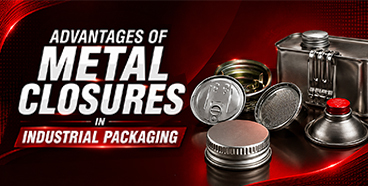
The category covers more than caps. In drum and pail systems it includes bungs and bung caps, tinplate and aluminium screw closures, crimped pail seals, tamper-evident capseals, and the metal components of locking ring assemblies. Each carries part of the sealing and security function, and they are usually specified together rather than individually.
Stacked drums place sustained compressive load on the closure area for months. Polymers respond to sustained load with creep, gradually deforming under stress that would not damage them in a short test. Metal does not creep meaningfully at ambient or elevated storage temperatures.
This matters more in Gulf and tropical conditions than temperature-controlled warehouses. A yard in July can push surface temperatures well past what a bench compatibility test simulated, and a closure that holds its geometry through that thermal cycle keeps its seal. One that relaxes does not.
Lubricants, base oils, thinners, aromatic solvents and many industrial chemicals sit in their containers for a long time. Prolonged contact with aggressive organic chemistry causes softening, swelling and environmental stress cracking in a range of closure polymers, none of which is visible at the point of fill.
Metal is chemically indifferent to most of these. The critical detail is the liner and any internal coating, since these carry the actual product contact. Correctly specified, a metal closure with a compatible liner gives a predictable service life across a much broader chemical range than a polymer equivalent.
Industrial supply chains involve multiple handling points between the filler and the end user. Product authenticity matters commercially, and in lubricants it matters enough that counterfeiting is a significant regional problem.
A crimped metal capseal cannot be removed and re-applied without visible damage. That is a meaningful difference from a closure that can be unscrewed, decanted and re-tightened to look untouched. When combined with a holographic or printed induction liner beneath it, the pack carries two independent layers of evidence rather than one.
Drums used for regulated goods are certified as complete packagings. The certification covers the drum body, the closure and the sealing hardware together, tested as an assembly. Substituting a closure that was not part of the tested configuration can invalidate the certification even if the replacement performs adequately in isolation.
Because metal closures are the configuration most certified drum systems were tested with, they remain the default for hazardous and regulated shipments. This is a compliance reason rather than a performance one, and it is often the deciding factor for exporters.
Steel drums have a well-established reconditioning economy. Drums are recovered, cleaned, inspected, refitted and returned to service, sometimes several times. The closure hardware has to survive that cycle, including cleaning at temperature and repeated opening with tools.
Metal closures and locking ring assemblies tolerate this. Moulded plastic components generally do not survive repeated reconditioning with their sealing geometry intact. Where a business operates a returnable drum pool, the closure choice is effectively made by the reconditioning cycle.
Steel and aluminium are recovered efficiently through established scrap streams and retain material value through repeated recycling. For businesses reporting on packaging recovery rates, metal closure components are among the easier lines to account for.
The qualification is that bonded liners and coatings complicate the stream. Specifying liners that separate cleanly improves the recovery outcome and is worth raising at the specification stage rather than after.
A balanced case has to include the limits. Strong acids, high-chloride solutions and some aqueous cleaning concentrates corrode metal from the inside, particularly at cut and crimped edges where the coating is thinnest. For those chemistries a well-specified polymer closure is the more reliable choice.
Metal also offers little where the pack needs dispensing functionality, repeated consumer reseal, or the lowest possible weight. Those requirements point elsewhere, and specifying metal against them produces an expensive pack that underperforms.
The advantages above are conditional on correct specification. Gauge and temper have to suit the application. Liner material has to be validated against the actual formulation, not the product category. Crimping equipment has to be set and maintained, because a correctly specified capseal applied with a worn tool seals no better than the wrong component.
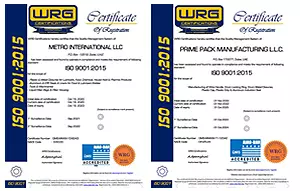
Metro International L.L.C manufactures metal closures, bung caps, capseals and locking ring assemblies for drum and pail packaging across lubricants, chemicals and industrial applications, and supplies the crimping and sealing tools to apply them consistently.
1.Are metal closures suitable for all industrial chemicals? No. They perform well with solvents, oils and most organic chemistry, but strong acids and high-chloride aqueous solutions can corrode metal at cut edges. Compatibility should be confirmed against the specific formulation.
2.Can metal drum closures be reused after reconditioning?Closure hardware such as locking rings is commonly reused across reconditioning cycles subject to inspection. Consumable sealing components such as gaskets and capseals are replaced each cycle.
3.Does changing the closure affect a drum's UN certification?It can. Certification applies to the packaging as a tested assembly, so substituting a closure outside the tested configuration may invalidate it. Confirm with the drum manufacturer before making a substitution.
4.How do metal closures perform in high-temperature industrial environments?Metal closures can maintain their structural strength across demanding temperature conditions, making them suitable for applications where packaging may experience heat during filling, storage, or transportation.
5.Do metal closures require liners for effective sealing?Depending on the container and application, metal closures may be used with suitable liners or sealing components to improve leak resistance and maintain product integrity.
6.Are metal closures suitable for products with long storage periods?They can be, provided the closure material and sealing components are compatible with the product and storage environment. Proper material selection helps maintain closure performance throughout the intended shelf life.