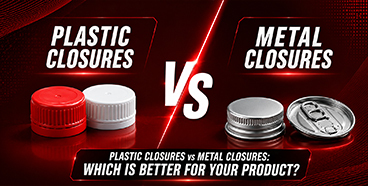
Asked in the abstract, plastic closures vs metal closures has no answer. Both materials dominate categories where the other would fail badly, and a comparison that lists generic advantages on each side leaves you exactly where you started.
The useful version of the question is narrower. What is in the container, what will happen to it between filling and use, and what does failure cost? Those three answers usually settle the material choice before anyone opens a price list. What follows is the sequence to work through.
Chemistry is the first filter because it eliminates options rather than ranking them.
Strong solvents, aromatic hydrocarbons, thinners and certain agrochemical formulations will attack many closure polymers over a long storage period. Softening, swelling and stress cracking follow, and the seal degrades even though nothing was wrong at fill. Metal closures, correctly lined, are frequently the more predictable choice for these.
The reverse holds for aggressive aqueous chemistries. Strong acids, high-chloride solutions and some cleaning concentrates will corrode uncoated metal from the inside, particularly at the cut edge. Here a polypropylene or HDPE closure with a compatible liner tends to outperform.
Most products sit in neither extreme, which is where the remaining criteria decide.
If the container goes through hot filling, pasteurisation, retort or steam sterilisation, metal handles the thermal load with far less distortion. Polymer closures soften as they approach their heat deflection range, and a cap that relaxes during processing loses the compression holding the seal.
Cold matters too, in the other direction. Some polymers become brittle at low temperature, which shows up as cracked skirts in cold-chain distribution or winter transport into northern markets.
For containers that are opened once and emptied, both materials seal reliably when specified correctly. The distinction appears where the container is opened and reclosed repeatedly.
Plastic closures generally give better reseal performance across many cycles. The thread engagement is more forgiving, and the liner recovers compression better than a deformed metal skirt. This is why household and personal care packaging is overwhelmingly plastic despite metal's other advantages.
Metal earns its place where the closure needs to be visibly, irreversibly tamper-evident, and where the seal has to survive rough handling. A deformed metal closure shows it. A plastic one can be re-seated and look untouched.
Plastic is lighter, which matters at export volumes. Across a full container of finished goods, closure weight is a small but real freight line, and lightweighting the closure is one of the least disruptive ways to reduce it.
Metal carries a handling consideration in the other direction. Cut edges and crimped surfaces present a safety point for operators and end users that plastic does not, which is why edge treatment and curl quality matter more than the price comparison suggests.
Unit price comparison favours plastic in most formats and volumes. Total cost of ownership is a different calculation and does not always agree.
Include the line speed each option supports, the sealing equipment required, the rejection rate at capping, the claims history and the cost of a single leakage incident reaching a customer. A closure that costs marginally more and reduces field failures by a meaningful margin pays for itself well before the end of the year.
For industrial drum and pail packaging, the calculation shifts again. Reconditioning and drum reuse depend on closure hardware surviving multiple cycles, and metal components hold their value across those cycles in a way moulded plastic generally does not.
Metal is straightforwardly recyclable and holds material value through repeated recycling, which is a genuine advantage. It is also heavier to transport and more energy-intensive to produce.
Plastic closures are recyclable in principle, but recovery depends on whether the closure separates cleanly, whether it is a compatible resin with the container, and whether the local stream accepts it. A mono-material plastic closure on a matching bottle is often recovered more reliably in practice than a mixed-material metal closure with a bonded liner.
The honest position is that neither material wins universally, and the answer depends on the recovery infrastructure in the markets you actually ship to.
1.Screen for chemical compatibility. This removes options rather than ranking them.
2.Check the thermal profile, including processing, transport and storage extremes.
3.Establish whether the pack is single-use or repeatedly resealed.
4.Define the tamper evidence the market and regulator require.
5.Compare total cost including equipment, line speed and failure cost, not unit price alone.
6.Confirm recyclability against the recovery streams in your destination markets.
7.Run a compatibility trial on the shortlist before committing.
Metro International L.L.C manufactures and supplies both across industrial and consumer applications, and can run comparative trials on your formulation before you commit to either.
1.Are metal closures always stronger than plastic?
Stronger under compression and heat, generally yes. But metal deforms permanently where plastic recovers, so for repeated opening and reclosing plastic often performs better over the life of the pack.
2.Which is cheaper overall?
Plastic usually wins on unit price. Once sealing equipment, line speed, rejection rates and failure costs are included, the gap narrows and sometimes reverses, particularly in reusable drum systems.
3.Can I switch from metal to plastic without changing my container?
Only if the neck finish and sealing surface are compatible with the replacement closure. In practice a switch usually requires re-validation of torque settings and the liner, and a fresh compatibility trial.
4.What factors should you consider when choosing between plastic and metal closures?
Consider the product's chemical compatibility, packaging material, required durability, sealing performance, storage conditions, transportation requirements, and overall packaging cost.
5.Are plastic closures better than metal closures for chemical products?
Not always. The right choice depends on the chemical formulation and container type. Plastic closures can offer good chemical resistance for many products, while metal closures may be preferred for applications requiring greater rigidity and mechanical strength.
6.Which closure is more suitable for long-term product storage?
Both plastic and metal closures can support long-term storage when correctly matched with the container and liner. The best option depends on product compatibility, temperature exposure, sealing requirements, and expected shelf life.