Every manufacturing process tells a story of precision. Whether it's producing pharmaceuticals, processing food, manufacturing paints, or treating industrial water, every drop of liquid must meet strict quality standards before it reaches the next stage. Hidden within these processes are microscopic contaminants that can affect product quality, reduce equipment efficiency, and increase maintenance costs.
This is where Industrial Filtration Solutions become essential. They act as the first line of defense, removing unwanted particles while protecting machinery and ensuring consistent product quality. Among the most widely used filtration methods are filter bags and cartridge filters. Although both serve the same purpose, they are designed to solve different filtration challenges.
Choosing between them isn't simply about selecting a filter—it's about understanding your process, contamination levels, flow requirements, and operational goals. This guide explores the strengths of each solution and helps you determine which filtration method best suits your application.
Modern industries demand efficiency, sustainability, and consistent product quality. Even a small amount of contamination can lead to production losses, equipment damage, or expensive downtime.
The right Industrial Filtration Solutions improve process reliability by:
This is why selecting the appropriate filtration technology should always begin with understanding your application's unique requirements.
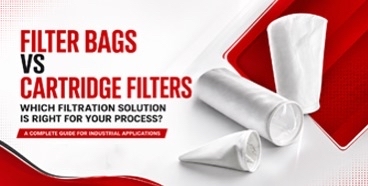
Think of filter bags as industrial workhorses. Their large dirt-holding capacity makes them ideal for applications where liquids contain high concentrations of suspended solids.
Instead of requiring frequent replacements, they retain large volumes of contaminants while maintaining strong flow rates. This balance between efficiency and cost-effectiveness makes them popular across industries such as:
For facilities processing thousands of litres every day, filter bags provide dependable performance while reducing maintenance interruptions.
Some industries require much finer filtration than others. Pharmaceutical manufacturing, cosmetics, electronics, and high-purity water systems cannot afford even microscopic contamination.
This is where cartridge filters excel.
Their pleated filtration media provides a larger effective surface area, allowing them to capture much finer particles with excellent consistency. These filters are engineered for applications where product purity matters more than contaminant-holding capacity.
When integrated into advanced Liquid Filtration Systems, cartridge filters help manufacturers achieve exceptional filtration accuracy while maintaining stable process performance.
Although both technologies remove contaminants, their strengths differ considerably.
Cartridge filters are designed for fine particle removal and applications requiring high purity.
Filter bags perform exceptionally well in general industrial filtration where larger particles need to be removed efficiently.
Filter bags can retain significantly more contaminants before replacement, making them suitable for demanding industrial environments.
Cartridge filters generally require replacement sooner when exposed to heavy contaminant loads.
High-flow manufacturing processes often benefit from bag filtration because it maintains excellent liquid flow with lower pressure loss.
Cartridge filters are better suited for applications where filtration precision outweighs processing volume.
Reducing maintenance is a major objective for every production facility.
Filter bags typically require fewer replacements during high-contamination operations, while cartridge filters offer longer service life in cleaner applications with lower particulate levels.
Selecting the right option ultimately depends on balancing productivity, maintenance schedules, and operational priorities.
Before investing in filtration equipment, ask these important questions:
Answering these questions helps determine whether bag filtration or cartridge filtration will provide the best long-term performance.
An equally important consideration is selecting the appropriate Filter Housings, as they ensure secure installation, proper sealing, and efficient operation of the complete filtration system.
Well-designed Liquid Filtration Systems combine compatible filters and housings to maximise filtration efficiency while minimising downtime.
Choosing between filter bags and cartridge filters isn't about determining which one is better—it's about understanding which solution best fits your process. Every industry has unique filtration requirements, influenced by factors such as particle size, flow rate, contamination levels, product quality standards, and maintenance expectations.
For applications that demand high dirt-holding capacity and continuous processing, bag filtration offers dependable performance and operational efficiency. On the other hand, processes requiring precise particle removal and exceptional product purity can benefit from cartridge filtration.
As industries continue to prioritize efficiency, sustainability, and cost optimization, investing in the right filtration solution becomes a strategic decision rather than just an operational one. By carefully evaluating your filtration needs and selecting the appropriate system, you can improve product quality, extend equipment life, minimize downtime, and achieve long-term process reliability. Ultimately, the right filtration solution is one that supports your production goals today while adapting to the demands of tomorrow.
The primary difference lies in their application. Filter bags are ideal for high-flow processes with larger contaminant loads, while cartridge filters are designed for fine particle removal in applications requiring high filtration precision.
The most cost-effective option depends on your process. Filter bags generally offer lower replacement frequency and maintenance costs for heavy-duty industrial applications, whereas cartridge filters provide greater precision for critical filtration processes.
The decision depends on factors such as the type of liquid being filtered, contaminant size, flow rate, and the level of filtration required. High-flow applications with larger particles typically benefit from bag filtration, while precision applications requiring finer filtration are better suited for cartridge filters.
Yes. An unsuitable filtration solution can cause pressure drops, frequent filter changes, reduced flow rates, equipment wear, and inconsistent product quality. Selecting the right filtration system helps maintain smooth and uninterrupted operations.
The service life depends on the operating conditions and contaminant load. Bag filters generally last longer in applications with high levels of suspended solids because of their larger dirt-holding capacity, whereas cartridge filters perform best in cleaner processes with lower contaminant levels.
Both are used across industries such as chemicals, food and beverage, pharmaceuticals, paints, water treatment, and oil & gas. However, the ideal choice depends on the filtration requirements of the specific process rather than the industry alone.